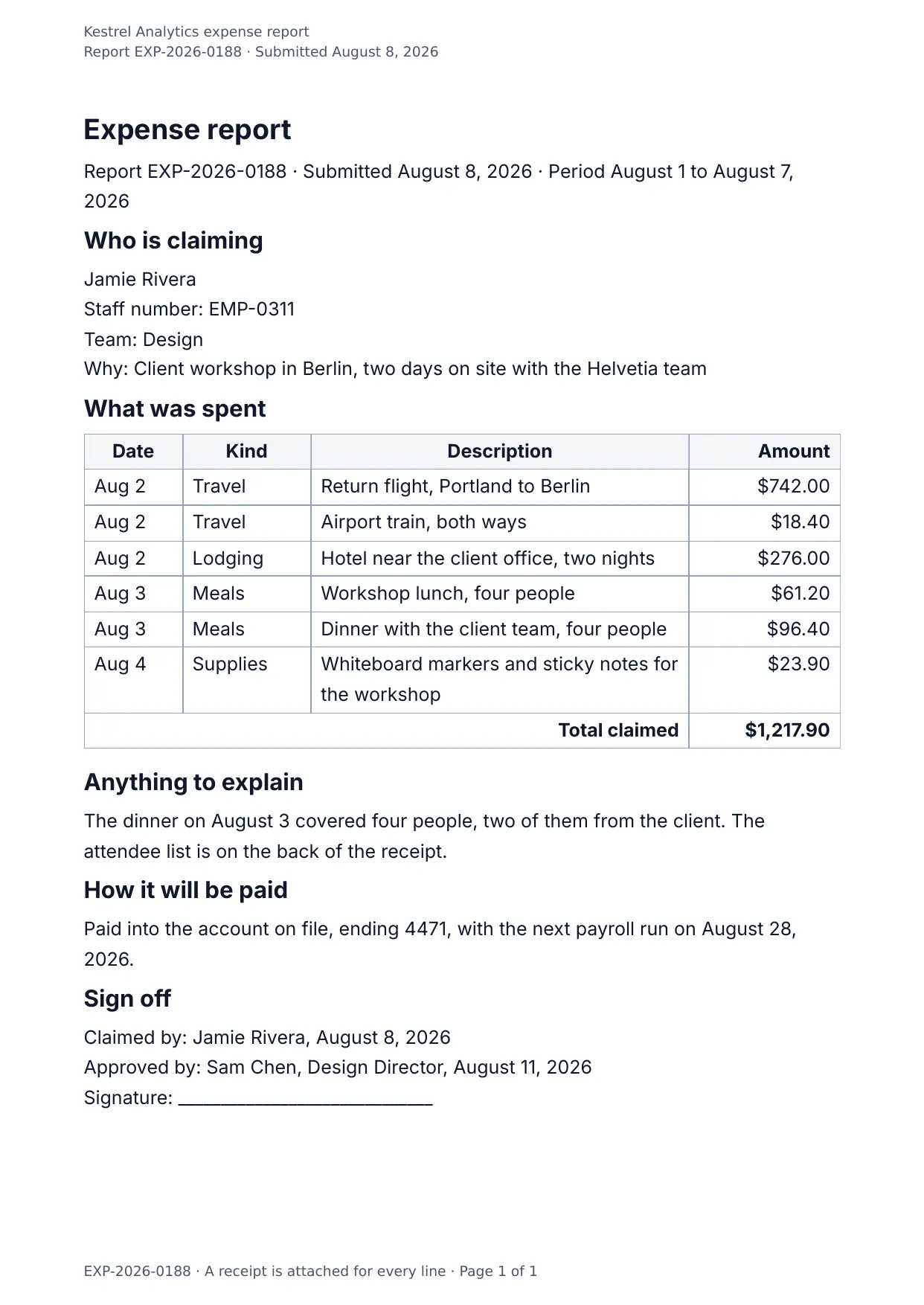
The first page of the document DocMake makes from the sample values on this page.
Finance
Expense Report
Expenses land in one tidy table: date, category, description, amount, growing with however many rows the trip produced.
Approval lines at the bottom make the sign-off explicit, on paper or on the PDF.
Blanks to fill
| report_number | Report number |
| submit_date | Submitted |
| period | Period |
| employee_name | Employee |
| employee_number | Staff number |
| department | Team |
| purpose | Purpose |
| total | Total claimed |
| notes | Anything to explain |
| reimbursement_details | How it will be paid |
| approver_name | Approver |
| approval_date | Approved on |
| company_name | Company |
| expenses[] | One per item, so a row is added for every item in the list |
The data behind the preview
This is the exact JSON that produced the document above. Change the values, POST them to the API, and you get your version back as DOCX or PDF. Lists grow and shrink with your data; the layout adapts.
- 01 Sign up free and duplicate this template into your workspace.
- 02 Adjust the wording and branding in the visual editor.
- 03 Fill it in the app, share it as a form link, or call the API.
{
  "company_name": "Kestrel Analytics",
  "report_number": "EXP-2026-0188",
  "submit_date": "August 8, 2026",
  "period": "August 1 to August 7, 2026",
  "employee_name": "Jamie Rivera",
  "employee_number": "EMP-0311",
  "department": "Design",
  "purpose": "Client workshop in Berlin, two days on site with the Helvetia team",
  "expenses": [
    {
      "date": "Aug 2",
      "kind": "Travel",
      "description": "Return flight, Portland to Berlin",
      "amount": "$742.00"
    },
    {
      "date": "Aug 2",
      "kind": "Travel",
      "description": "Airport train, both ways",
      "amount": "$18.40"
    },
    {
      "date": "Aug 2",
      "kind": "Lodging",
      "description": "Hotel near the client office, two nights",
      "amount": "$276.00"
    },
    {
      "date": "Aug 3",
      "kind": "Meals",
      "description": "Workshop lunch, four people",
      "amount": "$61.20"
    },
    {
      "date": "Aug 3",
      "kind": "Meals",
      "description": "Dinner with the client team, four people",
      "amount": "$96.40"
    },
    {
      "date": "Aug 4",
      "kind": "Supplies",
      "description": "Whiteboard markers and sticky notes for the workshop",
      "amount": "$23.90"
    }
  ],
  "total": "$1,217.90",
  "notes": "The dinner on August 3 covered four people, two of them from the client. The attendee list is on the back of the receipt.",
  "reimbursement_details": "Paid into the account on file, ending 4471, with the next payroll run on August 28, 2026.",
  "approver_name": "Sam Chen, Design Director",
  "approval_date": "August 11, 2026"
}
Generate this document via the API
One template plus changing data is the whole point. The list of blanks above is the contract, and every new set of values comes back in the same layout: fill it in the app, hand someone a form link, or POST the JSON and get the file straight back.
The request below carries this page's own values, so it runs as soon as the template exists in your workspace. Swap the values for yours and the response is your document.
curl -X POST https://app.docmake.io/api/v1/render \
  -H "Authorization: Bearer $DOCMAKE_API_KEY" \
  -H "Content-Type: application/json" \
  -H "Accept: application/json" \
  --output expense-report.pdf \
  --data-binary @- <<'JSON'
{
  "template_id": "tmpl_your_template_id",
  "format": "pdf",
  "data": {
    "company_name": "Kestrel Analytics",
    "report_number": "EXP-2026-0188",
    "submit_date": "August 8, 2026",
    "period": "August 1 to August 7, 2026",
    "employee_name": "Jamie Rivera",
    "employee_number": "EMP-0311",
    "department": "Design",
    "purpose": "Client workshop in Berlin, two days on site with the Helvetia team",
    "expenses": [
      {
        "date": "Aug 2",
        "kind": "Travel",
        "description": "Return flight, Portland to Berlin",
        "amount": "$742.00"
      },
      {
        "date": "Aug 2",
        "kind": "Travel",
        "description": "Airport train, both ways",
        "amount": "$18.40"
      },
      {
        "date": "Aug 2",
        "kind": "Lodging",
        "description": "Hotel near the client office, two nights",
        "amount": "$276.00"
      },
      {
        "date": "Aug 3",
        "kind": "Meals",
        "description": "Workshop lunch, four people",
        "amount": "$61.20"
      },
      {
        "date": "Aug 3",
        "kind": "Meals",
        "description": "Dinner with the client team, four people",
        "amount": "$96.40"
      },
      {
        "date": "Aug 4",
        "kind": "Supplies",
        "description": "Whiteboard markers and sticky notes for the workshop",
        "amount": "$23.90"
      }
    ],
    "total": "$1,217.90",
    "notes": "The dinner on August 3 covered four people, two of them from the client. The attendee list is on the back of the receipt.",
    "reimbursement_details": "Paid into the account on file, ending 4471, with the next payroll run on August 28, 2026.",
    "approver_name": "Sam Chen, Design Director",
    "approval_date": "August 11, 2026"
  }
}
JSON
tmpl_your_template_id is
a stand-in: build this template in the visual editor and copy the id it shows, or create one with POST /api/v1/templates. Keys, formats, strict mode and batches are in the API reference.
Or let an AI assistant do it
The DocMake MCP server lets Claude and other assistants make this document the same way. Install it once:
claude mcp add docmake \
  --env DOCMAKE_API_KEY=dm_your_api_key \
  -- npx -y @docmake/mcp@latest
Then ask for the document in plain words:
Make a PDF from my Expense Report template with report number "EXP-2026-0188" and submitted "August 8, 2026".
More finance templates
Commercial Invoice
The invoice that travels with an export: commodity code, origin and weight on every line, and a declaration to sign.
View template →Credit Note
The note that puts an overcharge right: what is being credited, why, and what it leaves owing on the invoice.
View template →Invoice
A bill with the work priced line by line, the tax and the total under the amounts, and how to pay it.
View template →